Channel View Estates
Inherent ViceChannel View Estates is Mickey Wolfmann’s large housing development on land where a South Central neighborhood had been cleared. Branded as “A Michael Wolfmann Concept,” it combines a sales image of Spanish Colonial homes and family life with unfinished infrastructure, an improvised construction-worker plaza, and the violent raid in which Glen Charlock is killed and Wolfmann vanishes. Its streets and lots are not a neutral backdrop: the project embodies a longer history of urban redevelopment, displacement, and unequal control of land.
Development and Setting
Aunt Reet, whose knowledge of Los Angeles property extends from individual lots to the region’s tangled land histories, identifies the project as Wolfmann’s latest large-scale assault on the environment. Its name appears in television commercials featuring Bigfoot Bjornsen, a police detective who moonlights as a real-estate pitchman. The slogan “A Michael Wolfmann Concept” turns the developer’s identity into a brand, while the development itself is presented as an appealing place to buy a home.
The approach from Artesia leads into broad housing fields beneath power lines and a hazy sky. At the site, model units stand near the road, finished homes lie farther in, and new construction continues beyond them toward unincorporated land. Doc parks on contractor hardpan at the future corner of Kaufman and Broad, where street signs are already installed although the streets remain unpaved. The tract’s geography is visibly provisional: foundations, utility trenches, storm drains, fill, bulldozers, and backhoes mark a landscape being made for future residents.
The completed houses borrow the look of higher-priced coastal towns through Spanish Colonial styling, red-tile roofs, and small balconies, but the resemblance is largely a sales image. The homes overlook a neglected branch of the Dominguez Flood Control Channel, isolated by fill, regrading, and industrial debris, and there are no shade trees in sight. The contrast between architectural promise and altered, under-serviced surroundings makes development’s visual polish inseparable from the physical work imposed on the site.
Displacement and the Politics of Land
Channel View occupies the place of a community rather than empty land. Tariq explains that South Central had been a Japanese neighborhood before the Second World War, when its residents were sent to camps and Black residents moved in afterward. Now, he says, the neighborhood is being moved along in turn. The development thus becomes one phase in a succession of forced changes in who can remain in a place and who is made to leave it.
That succession reaches beyond Channel View. The account places the clearance of Tariq’s neighborhood alongside Mexican families displaced from Chavez Ravine for Dodger Stadium and American Indians removed from Bunker Hill for the Music Center. These different histories are presented as part of Los Angeles’s long record of land use: civic and commercial projects remake neighborhoods, while those who lived there bear the cost of the transformation.
The dispute is not only about a development’s appearance or environmental effects. Mickey’s opponents include established residential owners who describe themselves as defending the environment and resisting high-density housing, while their critics identify property values as the underlying concern. Crocker Fenway frames the conflict instead as a struggle over being “in place,” invoking enduring claims to real estate, water rights, oil, and labor against a transient population. Channel View therefore exposes the tension between the language of preservation and the interests that can hide inside it: opposition to one kind of development does not by itself undo the unequal possession of land.
The Construction-Site Plaza and the Raid
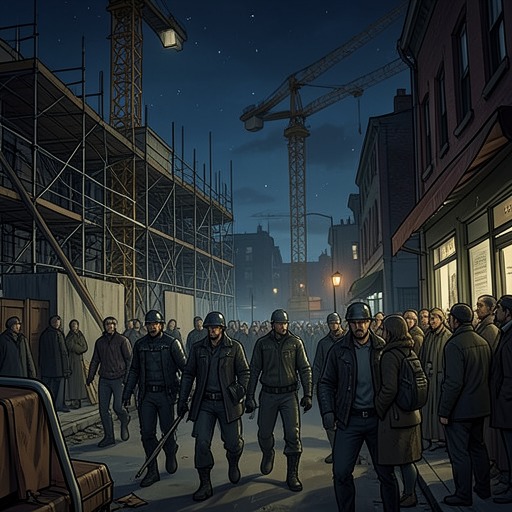
Near the planned front gate, a makeshift plaza serves the people working on the construction site. It includes a liquor store, a sandwich counter, a beer bar with a pool table, and Chick Planet Massage, outside which motorcycles are parked in orderly rows. Doc takes the plaza to be a likely place to find Wolfmann’s associates and enters Chick Planet to ask after a man working for him. The temporary commercial strip, set beside a rapidly expanding tract, becomes the point of entry into the events that make Channel View more than a development story.
A later screening of Farley’s 16-mm footage shows masked gunmen arriving in camouflage and establishing a perimeter around the plaza. They cross the flood-control channel, secure bridges and footbridges, and surround the site, while the motorcycles that had been outside Chick Planet disappear. The camera also catches Wolfmann’s motorcycle entourage racing through the development, apparently uncertain what to do. The raid’s movement across the channel and through the tract turns the new infrastructure into operational terrain: bridges and streets that promise access to future residents also shape the armed party’s approach and containment of the plaza.
The film records Glen Charlock being shot by one of the masked gunmen. Glen is unarmed; the attacker takes aim and fires controlled bursts. Because the footage was shot on a spring-wound camera with short reels and rotating lenses, it is uneven and incomplete, but the killing itself is plainly visible. The images establish that Glen died during the raid, while leaving the gunman’s identity unreadable. The development’s promise of orderly family housing is thus set against evidence of lethal violence recorded on the very site being prepared for occupation.
Disappearance, Surveillance, and Aftermath
During the raid, Wolfmann disappears. Bigfoot presents the incident as a homicide investigation complicated by the impending possibility that federal authorities will classify Wolfmann’s absence as a kidnapping and take over the case. He presses Doc to identify the other people involved, treating the development’s gathering of associates and motorcycle riders as evidence of a wider conspiracy. The disappearance makes Channel View a contested space not only between residents and developers, but also between local and federal authorities seeking control of the investigation.
The site’s surrounding homes and business are also bound up with surveillance and unease. Boris reports that Wolfmann had rented a Hancock Park house for Sloane Wolfmann and that she felt safer when someone was with her. She had seen cars circling, received calls with no one speaking on the other end, and been followed when she went out. These details do not establish who was responsible, but they place the real-estate project within a wider climate of watching, pursuit, and suspected plotting around Wolfmann and his circle.
The development remains a visual and material record of the investigation after the raid. Years or stages of construction are compressed into the image of foundations awaiting houses, trenches for utilities, blinking barricade lights, and heavy machinery near the gate. Farley later leaves Doc enlargements from the raid, but none resolves the masked shooter’s identity. The photographs preserve the event while withholding its final answer: the past can be revisited, yet the evidence itself remains blurred.
Narrative and Urban Significance
Channel View links the intimate scale of a lot and a household to the metropolitan scale of highways, flood-control channels, and neighborhood clearance. The approach from Artesia, the unfinished streets, and the construction plaza give the development a specific geography; Tariq’s account and the comparisons with Chavez Ravine and Bunker Hill give that geography a history. Together, they show how urban change is carried out through concrete sites and infrastructure, not merely through abstract plans.
The project’s environmental character is similarly double. Its builders reshape land with fill and regrading, build beside a channel cut off from its former surroundings, and extend construction toward unincorporated territory. Farley, a veteran who has filmed environmental damage, sees Channel View as resembling clearings he knew from war. That comparison connects the tract’s ordinary work of development to a more visible history of landscape destruction, while the delayed and dispersed effects of construction remain easy to overlook beneath its sales language.
Finally, the contrast between the television pitch and the raid footage makes Channel View a study in competing images of the same place. In commercials, Bigfoot performs a comic, family-facing role amid children and model-home furnishings; in the investigation, the site is a landscape of armed men, a killing, and an unresolved disappearance. Neither image erases the other. The tract’s significance lies in their coexistence: a promised community rises on displaced ground, while the violence and uncertainty attending its construction resist being smoothed into the developer’s concept.